Save More with These Income Tax Deductions!
Are you a salaried employee looking to reduce your tax liability? You can legally lower your taxable income and save money using various deductions. Here’s how you can make the most of tax-saving options in FY 2024-25.
- Essential Tax Deductions You Must Know
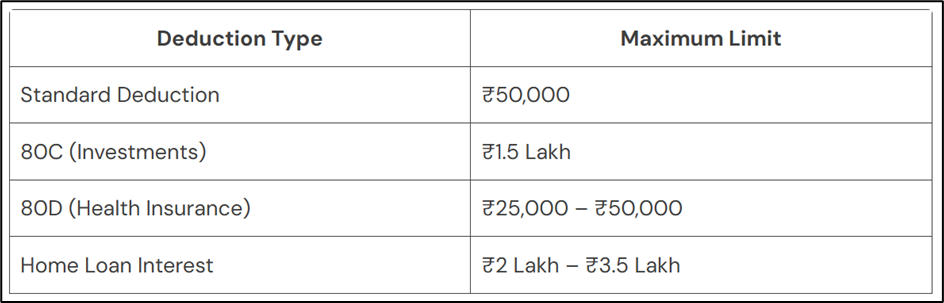
Standard Deduction (Flat ₹50,000)
Every salaried individual gets a standard deduction of ₹50,000. This applies to both the old and new tax regimes.
House Rent Allowance (HRA) – Section 10(13A)
If you live in a rented house, you can claim HRA exemption. The deduction is the least of:
* Actual HRA received
* 50% of salary (metro) or 40% of salary (non-metro)
* Rent paid minus 10% of salary - Popular Tax-Saving Investments
Deductions Under Section 80C (Limit: ₹1.5 Lakh)
You can invest in the following to claim deductions:
* Employee Provident Fund (EPF)
* Public Provident Fund (PPF)
* Life Insurance Premiums
* ELSS Mutual Funds
* 5-Year Fixed Deposits
National Pension System (NPS) – Section 80CCD
* Additional ₹50,000 deduction over and above the 80C limit under Section 80CCD(1B).
* Employer’s contribution (up to 10% of salary) is deductible under Section 80CCD(2). - Health & Home Loan Deductions
Medical Insurance – Section 80D
* Self, spouse, children → ₹25,000
* Parents (below 60) → ₹25,000
* Parents (above 60) → ₹50,000
Home Loan Interest – Section 24(b) & 80EEA
* ₹2 lakh deduction on home loan interest under Section 24(b).
* First-time homebuyers can claim an additional ₹1.5 lakh under Section 80EEA.
Did You Know?
You can claim an additional ₹5,000 for preventive health check-ups under Section 80D!
Final Thoughts
By utilizing these deductions wisely, you can save thousands in taxes. Invest smartly and make the most of your hard-earned money!

Rupesh Jadhav is the founder of Rupesh Financial Expert, a finance-focused website dedicated to helping Indian investors make informed financial decisions. He writes about mutual funds, SIP investments, government schemes, retirement planning, and personal finance. His goal is to simplify complex financial concepts through research-based and educational content.