'%3E%3Ccircle%20r='92'/%3E%3Ccircle%20fill='%23fff'%20r='80'/%3E%3Ccircle%20r='16'/%3E%3Cg%20id='c'%3E%3Cg%20id='b'%3E%3Cpath%20id='a'%20d='m0-80%203%2048L0-8-3-32M21-77%2011-30%202-8%205-32M40-69%2019-26%204-7%2013-29'/%3E%3Cuse%20href='%23a'%20transform='scale(-1)'/%3E%3C/g%3E%3Cuse%20href='%23b'%20transform='rotate(45)'/%3E%3C/g%3E%3Cuse%20href='%23c'%20transform='rotate(90)'/%3E%3C/g%3E%3C/svg%3E)

Hello Taxpayers and Investors! 👋
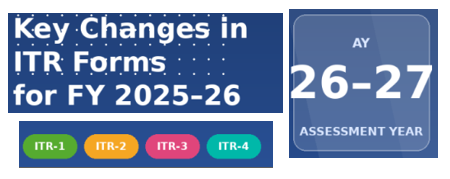
If you are a salaried professional, a retail stock investor, an active F&O (Futures & Options) trader, or an intraday speculator, the upcoming tax filing season requires your utmost attention. The Income Tax Department has officially notified the revised Income Tax Return (ITR) forms for Assessment Year 2026–27, which are applicable to all incomes earned during the Financial Year 2025–26 (April 1, 2025 – March 31, 2026). If you have invested, traded, or sold property this year, these structural updates affect you directly. 📑
The newly introduced forms expand reporting requirements significantly around capital gains, share buybacks, derivatives trading, and high-value transactions. Reflecting the government’s continued push toward granular, source-linked income reporting, these updates aim to foster transparent compliance. Selecting an incorrect ITR form can immediately trigger a Defective Return Notice under Section 139(9).
Here is the clean, table-led summary of what’s new across each form based strictly on the official document parameters. 🎯
📊 1. Form Applicability at a Glance
Before examining the revisions, let us verify which individual ITR form matches your specific financial footprint for the year:
| Form | Who Should File |
| ITR-1 (Sahaj) | Salaried individuals, pensioners; income up to Rs 50 lakh |
| ITR-2 | Individuals with capital gains, multiple properties, foreign assets |
| ITR-3 | F&O traders, intraday traders, business & professional income |
| ITR-4 (Sugam) | Presumptive income from business or profession (44AD/44ADA/44AE) |
🔍 2. What’s New in Each Form
Here is the exact structural table tracking the key updates introduced across the updated ITR forms:
| Form | Key Updates |
| ITR-1 & ITR-4 | Income from up to 2 house properties now allowed · LTCG under Section 112A up to Rs 1.25 lakh can be reported · New secondary contact fields added. |
| ITR-2 | Detailed capital gains breakup · Separate disclosure for buyback losses · Enhanced foreign asset reporting. |
| ITR-3 | Granular reporting for F&O and intraday trading · Buyback losses captured separately · Expanded business & trading disclosures. |
💡 3. Key New Disclosures
Understanding the underlying logic behind these newly introduced line items is crucial for a smooth filing experience:
| Disclosure | Why It Matters |
| LTCG (Section 112A) | Equity gains up to Rs 1.25 lakh can now be filed even via simpler ITR-1/4. |
| Buyback Losses | Reported as a separate line item to align with the new buyback tax regime. |
| F&O / Intraday Trading | More detailed turnover & profit reporting expected from active traders. |
| Foreign Assets & Income | Stricter disclosure aligned with global tax-transparency norms. |
| High-Value Transactions | Helps the department cross-check filings against AIS/SFT data. |
📅 4. Important Dates
Ensure you note down these official timeline parameters to organize your reconciliation schedules:
| Parameter | Key Date / Timeline |
| Forms Notified On | March 31, 2026 |
| Financial Year | FY 2025–26 (Apr 1, 2025 – Mar 31, 2026) |
| Assessment Year | AY 2026–27 |
💡 Final Word
The revised ITR forms clearly reflect the government’s continued push toward granular, source-linked income reporting. Whether you’re a salaried filer with small capital gains or an active F&O trader, picking the right form—and reporting every disclosure correctly—is more important than ever. Filing the wrong form can lead to a defective return notice under Section 139(9).
Start gathering your broker statements, AIS data, capital gains reports, and bank summaries early. The earlier you reconcile, the smoother your return will be.
Disclaimer: This article is for informational purposes only and does not constitute tax advice. Please consult a qualified tax professional.

Rupesh Jadhav is the founder of Rupesh Financial Expert, a finance-focused website dedicated to helping Indian investors make informed financial decisions. He writes about mutual funds, SIP investments, government schemes, retirement planning, and personal finance. His goal is to simplify complex financial concepts through research-based and educational content.